

I
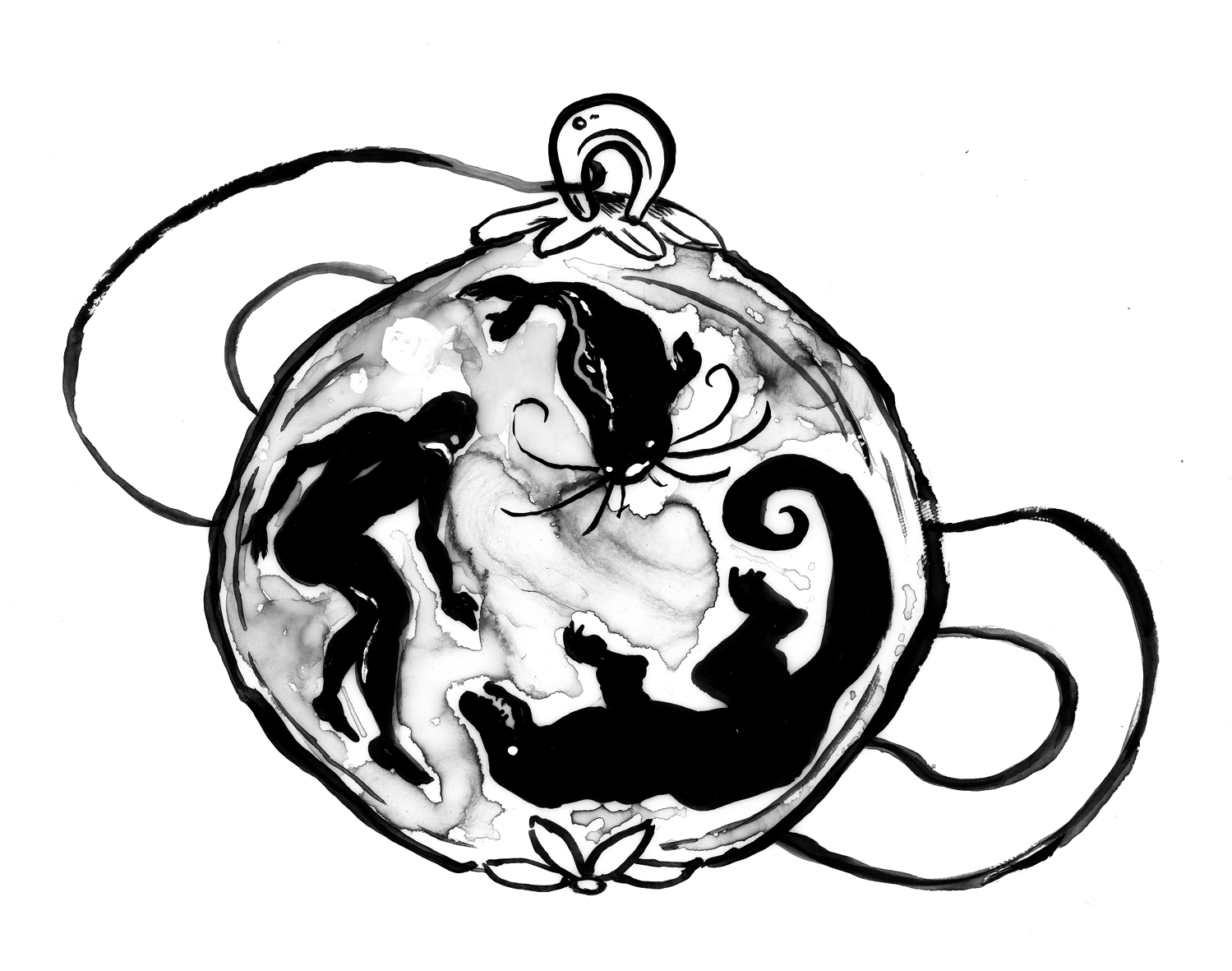
A crocodile is a crocodile is a crocodile, and a man is a man is a man. Does that sound like a truism? Well, it’s not. Afonso Garcia de Solis, for one, was a crocodile was a man was an explorer from Europe and, according to an anthropologist, was a catfish who—out of pure bad luck—ended up being eaten by his own children for lunch.
My friends and I had come to West Tulang Bawang, Lampung, on the invitation of the regent. He was thirty-five years old, with big plans to make his district not just peaceful and prosperous and free from swine flu, but also a pioneer in cool new cultural offerings. This young regent wanted West Tulang Bawang’s stories to be written down and written well, something better than dusted-off old artifacts. So my friends and I, we each came with our own skills to fulfill his desire.
We first gathered at the residence of a tradition-bearing elder in the hamlet of Penumangan to interview two doddering old men. Then my friends went to see a cannon that was said to have a peculiar hobby: it had been wailing loudly ever since it had shot down the flying prayer mat of a missionary from Banten six hundred years ago. Meanwhile I slipped away and started chatting with a fuel retailer named Danil. Danil looked like Clint Eastwood when Eastwood was directing Mystic River, he was selling gasoline in what appeared to be giant milk bottles, and it was from him that I heard about Afonso for the first time.
Afonso Garcia de Solis read Ibn Batutta’s Rihla when he was fourteen. Two years later, he and a cousin from his mother’s side enlisted in the royal navy. When he was thirty-four, half a decade after his cousin’s departure on a second quest to search for the new world, Afonso received orders to lead a ship on an expedition. But his destination was the old world, the part of it that was still rich.
Afonso envisioned the lands of the Spice Islands for a long, long time. Month after month went by. Storms and dead wind. Bad luck and terrible misfortune. Various port cities, each with their own charms and distinctions. The voyage enriched his knowledge, yet did not detract a whit from his imaginings of islands teeming with dances and gleaming with sun, of proud men wearing epaulets adorned with flying horses and head wraps made from tiger hide, of shapely women wrapped in silk that hid deluxe adornments—gold and silver hoops baubled with precious stones encircling their belly buttons and tracing the curves of their labia.
It wasn’t the difference between dreams and reality that disappointed Afonso, but the Admiral’s orders. The Santa Clarina, Afonso’s ship, had to stay in the southernmost waters of Samudera Island, with several other ships and their crews. Afonso was appointed leader. His task: ensure the continuity of the spice trade with the Banten Sultanate—and, through other more secretive routes, the trade with a number of Palembang Sultanate nobles—and thus maintain the balance of power in the region.
They built barracks for six days. On the seventh day, a couple approached Afonso: a partially paralyzed old man leaning on a sturdy young woman who was blind. The man looked like an exhausted prophet and had a lump the size of a baby’s head protruding from his brow. The young woman claimed she had joined the voyages of merchant ships to the ends of the earth and back, and had learned all she needed to learn from this mortal world, including multiple foreign languages, before scratching her eyeballs out with her very own fingernails. The man introduced himself as Pangolin Head Menak and relayed a prediction that Afonso would play a significant role in the history of the region. He also said he would help, by offering the young woman who was supporting him to Afonso in marriage—along with a powerful amulet. The small thing, which looked like a clod of dirt, was to be swallowed by its recipient should he ever find himself in dire straits.
To me, the story seemed nonsensical and far-fetched. Though I understood the nature of oral tradition, I couldn’t help asking Danil how he could know all of that. “I’m their descendant,” he said. Then he leaned toward me, opening his right eye wide and holding the lids apart with his thumb and forefinger.
“There’s a hint of blue, isn’t there?” he asked.
“As blue as the ocean,” I replied with a nod.
At that moment my friends emerged from and descended the steps of a stilt house. I took my leave of Danil and approached them. One said I’d really missed out on a story about the local people’s oldest “pepadun”—a throne they sat on to assume customary titles. They said it was four centuries old and the master metalsmith who had made it had risen to the heavens in moksa, poof, as soon as his work was done. The others had been recording the papaya trees, the busted boats which lay overturned in the gutters, the chicken coops, the old wells, the packs of local cigarettes, and whatever else was around, since we’d arrived in the district with our phones at the ready. Clearly, everyone except for me already knew what they were going to write about, or at least had a plot in mind, a few characters, an atmosphere. I regretted having already spent the advance I’d been paid by the organizers.
• • •
II
We set out for Pagar Dewa, making our way by water. A few of my friends had looked concerned when this idea had first been proposed in the meeting, but they relaxed again as soon as the committee had reassured them there would be life jackets for everyone. In fact, I didn’t get one. I clambered into the smallest motorboat with two friends, plus the driver, who was wearing a helmet but also no life jacket. As soon as my feet touched the boat, the sensation of the water’s surface moving underneath made my heart flutter, as if I was touching myself for the first time.
I estimated the river was about twenty meters wide. Judging by the shallow fortifications on the banks on either side, it was quite likely it wasn’t even ten meters deep. The only plants growing besides water hyacinths and shrubs were a kind of tree with dark gray bark and dark brown fruit which looked like human waste when submerged in the water. Whenever another boat pulled up alongside or passed us, a big splash of water would drench my pants. I kept looking up, hoping to spot a kingfisher or a serpent eagle or a white egret or a red heron swooping by, but there were no birds. My legs were soaked in muddy water and my neck was stiff and the only remarkable thing I could see was fruit that looked like little nubbins of shit.
Our skiff arrived at an estuary where the Left Way, Right Way, and Tulangbawang Way converged. Without being asked, the boat driver took the initiative to bring the boat to a stop and launch into a folktale, one that was said to have come to pass right around that confluence.
Once upon a time, a sage named Pangolin Head Menak and his followers, who for decades and decades had lived on the banks of the estuary, retreated to higher ground when armed men arrived from Banten. The men said they had come in peace and wouldn’t force their beliefs on anyone. And they were speaking the truth—all they did was turn Pangolin Head Menak’s sanctuary into a mosque, build barracks, and establish a tax of one sack of pepper or the equivalent value a head, to be collected every four months if the sage and his followers wanted to keep living there.
After the final negotiations, Pangolin Head Menak submerged himself in the estuary waters, scrubbing the dirt and rage from his body. Twelve nights later, under a full moon, a flock of humans with blue eyes and white skin and muddy white tails and fangs as long as daggers crept up onto land and tore into the necks of everyone in the settlement—except, of course, one man who they spared so he could return to Banten and report what had happened.
The Sultan and his advisors were not superstitious men. So, they interpreted the survivor’s account this way: the Hindus in Tulangbawang had allied with a foreign nation—the same nation that now was controlling the port of Malacca and most of the spice trade in the region—against the Banten Sultanate. The messenger himself was beheaded after a trial found that he and his friends were drunk when the foreigners came to attack.
Three weeks later, the Sultan of Banten sent one thousand and seventy-three ships to Tulangbawang, and every single man in the convoy almost choked on their own eyeballs after witnessing the barracks actually inhabited by crocodiles—river crocodiles, of every size, not human-crocodiles, or even human-human foreigners who looked like crocodiles to intoxicated men. A few soldiers testified that they could still see the fingers and ears and torn pieces of flesh sticking out from between those crocodiles’ teeth the entire journey back home to Banten.
But of course, there was also that which they did not report to the palace: though they had been able to recapture the barracks and the mosque, the soldiers had been forced to let the largest crocodile escape into the river. Neither spear tip nor rifle shot could pierce the creature’s hide. The crocodile was one to one-and-a-half fathoms wide, and fifteen to twenty-five spears long. It had blue eyes, white skin, and a snout as large as two cannons lined up end to end.
“They called that crocodile Alfonso,” said the boat driver.
My ears perked up. “Afonso?” I asked.
“No, Alfonso, like the leader of the Portuguese in Malacca back then.”
• • •
III
In Pagar Dewa, we visited the house of yet another tradition-bearing elder to listen to his story. I didn’t slip out because this source didn’t seem as senile as the ones before. But I still didn’t get enough material. The man talked almost exclusively in his local language, and no one in the group who could speak it moved to translate. Words that sounded like twigs cracking and feet squelching down into the mud crowded my ears, and I was only able to discern three snatches of information from what he said: “my memory is going,” “I already told this all to Mr. Tony,” and “Mr. Tony came from Malaysia, or Sulawesi, with about ten others, and he was their leader.”
In the middle of the meeting, one of my friends jumped up and ran out, screaming. He almost plunged into the river when a piece of wood that had been thrown by a villager struck the back of his neck, knocking him unconscious and sending him rolling. When he came to he just laughed and laughed, saying he felt like he had no head, claiming to know nothing about all the commotion he’d caused. Our group leader decided to forget the whole thing and move on. The tradition-bearing elder of Pagar Dewa of course had something to say, but, just as before, I didn’t understand—and nobody cared whether I understood or not.
We were only scheduled to be in Tulang Bawang for three days, and that was the last day. The next day and the day after that and the day after that I was back in Jakarta, still unable to figure out what to do with these bits and pieces of tales. If the task had been to invent my own story, I could have certainly done it quickly. I had plenty of ideas I could call upon, to use whenever and however I wanted—about creatures from outer space or a mystery woman or bad dreams or evil thoughts or fistfights or journeys on a train. But apparently requests for stories like that were on the decline.
I was already prepared to accept that I would never be hired to write any kind of story by anyone ever again when I happened upon an article on the internet about folktales in Lampung, an excerpt of ethnographic research. The author was named Nanang Suprihantoni, and at the end of the article a brief bio stated that he was an anthropology professor at Universitas Padjajaran, Bandung. Frankly, the article was practically unreadable to me, because it all seemed to be a repeat of the first paragraph. But, somewhere in the middle, there was one section that I could turn into the end of this tale. And I quote:
“As stated above, the people of Lampung also have tales that are hard to process (sic!) through reason. One example is the tale of Alphonse Rabelais, a mercenary captain from France who came to Tulang Bawang (now West Tulang Bawang), Lampung, on a Portuguese ship in the 15th century. According to local citizens, Alphonse was the only foreign legion (sic!) who survived the surprise attack of the Palembang Sultanate, which uncovered the black-market trade between the foreign nation and a number of their noblemen. Leaving his compatriots, Alphonse, who’d been shot in the side and the chest, escaped by throwing himself down into the river, right in the estuary where the waters of Tulang Bawang Way, Right Way, and Left Way meet. Local people believe that the man, thanks to his alliance with a witch doctor named Pangolin Head Menak in the resistance against Islamic encroachment, had an amulet that allowed him to change form. Not long after that, it is said, the people of Penumangan—one of the villages on the banks of the river—found a catfish as big as a man, bleeding profusely. They brained the fish, but only one family dared eat its flesh. This latest bit of information was given to researchers by a gasoline seller in Penumangan. The man was named Daniel and he claimed to be a direct descendant of the family that ate the giant catfish.”
• • •
