

The trick to taking over the world is just this: keep moving.
First, you have to survive the apocalypse, of course. That’s mostly chance. An earthquake, a mudslide, a flood . . . you take what you get. Then, you get your wits about you—if you can, as best you can—and then . . . you move. In a disaster—particularly a world-ending, catastrophic disaster—people are drawn to anything that moves. They want to move with you. They want to get away from whatever just happened. They want to get on with their lives, even while the world is ending. They want to do something, but they don’t know what or how. All you have to do is move, and the lost, broken people around you will stop sitting in the rubble, and move with you. And—as it turns out—when the world’s in pieces around you and still falling apart, motion is two-thirds of survival. Things that sit still for too long get crushed, get sick, get eaten. They die. The people who followed you? Well, they look back at all the ways they could have died and didn’t. Proof positive you know what you’re doing. You keep your mouth shut, and keep moving. They’ll keep following, because you’re the leader, now.
They trust you.
The first time you do it, it’s an accident. The first noticeable earthquake of the season had ended, and people were coming out of their houses to see the damage. There wasn’t a lot. Not even by the high standards you had, back then. A few roof tiles had fallen. A few power lines were down. From all appearances, everyone could go back inside and wait for the construction crews to fix things. None of the buildings had fallen down. Nothing was on fire. No one was hurt. You were safe enough to think things would go back to normal, if you just picked up your photographs and swept up the broken glass. It wouldn’t faze a real Californian. When the news reports started coming in, you’d figure out what you could do for people who weren’t as lucky, and start working on that.
You didn’t know until later that the epicenter of that earthquake was somewhere in Missouri.
You didn’t know just how much an act of genocide half a world away would magnify the aftershocks, or how delicately balanced it all was. Land and wind and ocean currents. The seismic wave from Missouri hits the shock wave from a bomb in Palestine, and then all the echoes start bouncing around. All anyone could do was wait for it to stop.
• • •
Afterward, nobody asks why you started walking in the first place. The important part is you did. They owe their lives to that choice. They watched the people who didn’t follow get crushed to death under the mudslide that came after the initial quake. You’re not a bona fide prophet yet, but somewhere, in the back of their mind, somehow . . . there’s that little tingle. You’re someone special. A miracle. How did she know? No one else did. How did we escape?
No one wants to believe it was just chance. No one wants to believe that if you’d turned left instead of right, they’d be just as dead as their buried neighbors. No one wants to believe that life and death hinge on the fact that your six-year-old animal lover saw a squirrel, dropped her lunch box, and ran toward the park instead of the beach. They want to believe they’ll always be safe. That they’re chosen. God had his reasons.
You half believe that Amara’s squirrel was a sign yourself. It’s easier than admitting it all rested on the roll of dice, or the whim of a fluffy rodent.
If your husband’s response to his windshield being smashed had been better—if he had thought of the insurance before he thought of how much that car cost—you wouldn’t have gone for a walk to give him a breather.
He wouldn’t have hurt you or the girls, of course, but you didn’t want them to see their father grieving over a car, when there might be people out there who had lost everything. Priorities. You both agreed not to raise your kids the way your parents raised you.
Your last words to him were irritated. Loud. Cheerful enough to embarrass the worst actor on Broadway. “The important thing is nobody’s hurt,” you didn’t quite shout, as you pulled the children away.
His last words to you were frustrated. You could tell he was trying to stay calm, and remember that even a classic car is just a thing that can be replaced. “I know, but—”
You understand the “but.” You do. There’s an uprooted linden tree on and in and under his 1967 Camaro. The car he’d dreamed of all his life. A splash of glass on the ground tells you the car is not okay.
You only intended to take a walk around the block. Maybe to the park and back. You didn’t even think to grab a sweater before you left, and you always grab a sweater. Bay Area chill.
You were just as shocked as anybody, when the hill collapsed and slid away. Too shocked to notice you were alive. Too shocked to realize your husband was dead.
The children know.
They don’t know that dead means he’s never coming back, but they do know he’s dead. Dead. It’s the baddest thing they know. It’s what happens when a hill falls on you. Beyond that . . .
For a while, you and your children are the only people staring down at the mud.
Then, there are others.
A few of the people staring with you are people from houses you can’t see anymore. The people from the neighborhood you just wandered into are staring down at the mud with a more analytical gaze, wondering if their own houses are next. They don’t know any of the people who were just swept away.
The old woman from next door half sits, sliding all the way down to the curb, too shocked even to whimper. She was on her way back from the store. Her canned tuna rolls away from her, and out of anyone’s reach. The houses you lived in are completely swept under, now. A little rubble in the distance, where the wave of mud pushes timber out into the ocean, but you can’t tell whether the lumber is from your house, or hers, or someone else’s. Lumber. Boards broken apart from your homes. Wooden houses were supposed to withstand earthquakes better. This wasn’t supposed to happen.
She saw everything, and just . . . stopped.
You recognize the impulse. You have to force yourself to keep going. You have to drag the kids. You want to quit, but you don’t feel safe, yet. There’s no real reason for that. You don’t even consciously think about how close you are to the edge. You just want to keep going until you can’t see the destruction anymore.
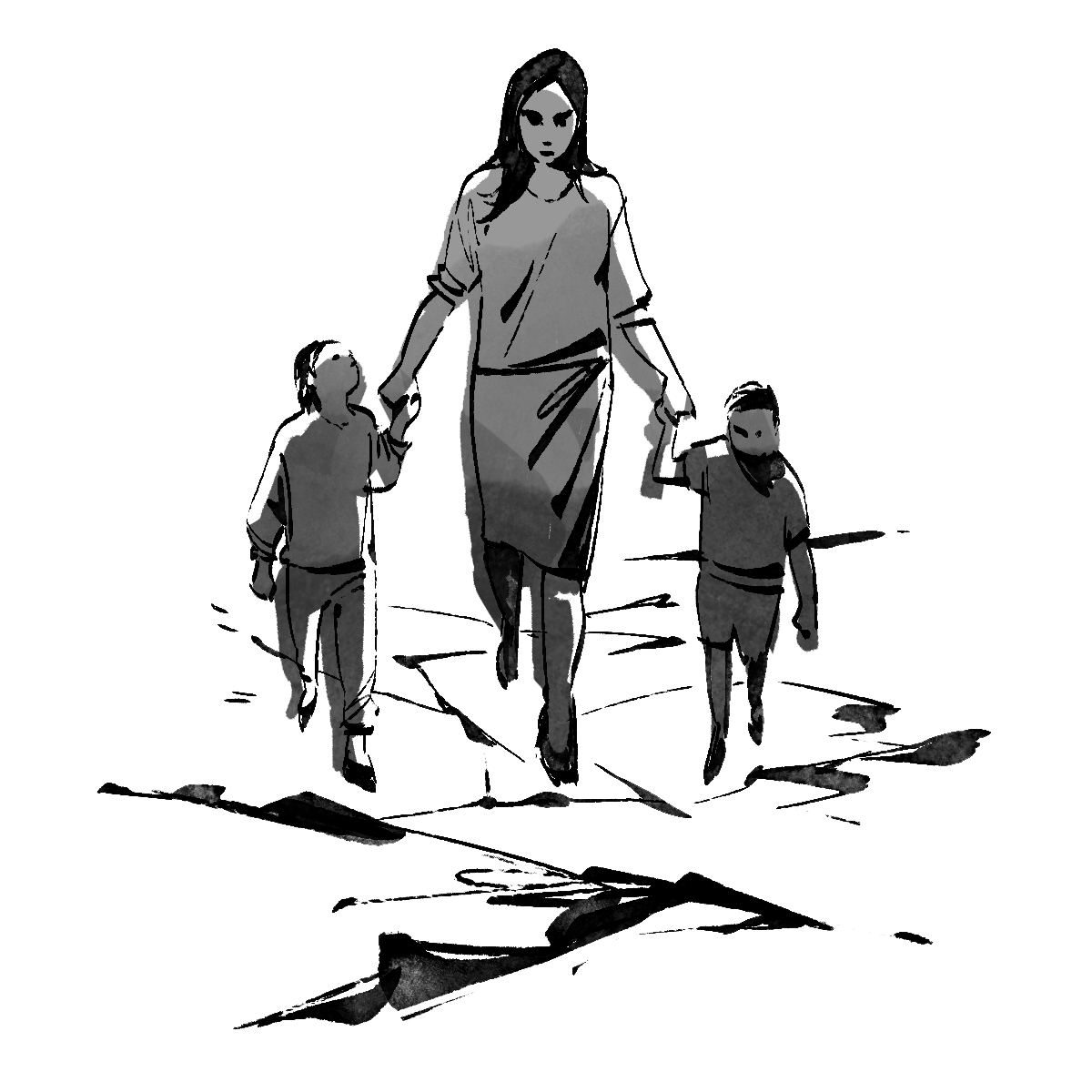
You keep walking. Your nine-year-old takes the little one’s other hand automatically, and you’re grateful, because it’s as close as you can come to grabbing all three kids all at once.
• • •
The earthquakes keep coming, and the rain never stops. If you learned how to deal with this in Girl Scouts, or on YouTube, you don’t remember. From the moment the mud crushed your home until now, it has been nothing but putting one foot in front of the other. Doing what seems the most reasonable in a given moment, and hoping for the best. Paying attention to the things that are going on around you. None of it is supernatural. None of it’s even particularly lucky. You’ve learned that mud will crush a house, it will uproot a tree, but it will go around a mountain or a hill. You’ve learned that the animals from the forest are less suited to the city; you can run down a deer, if you have a dead-end alley and a pack of hungry humans. You never really stop being hungry, but you’re alive. You don’t starve.
And the people who have followed you from the beginning. Who have watched you make one lucky guess after another after another . . . they’re starting to believe you can work miracles.
It’s gone from being self-interest to something closer to religion.
You suspect they would believe you could part the sea, or turn water into wine.
But now, clean water is more of a miracle than wine could ever be. You let the water speak for itself. And anyway, what are you supposed to say? Hey, guys . . . about this godhood thing? You know I’m not any kind of messiah, don’t you? You know I can’t save you, right? You just keep moving. The religion builds itself without any encouragement. Your acolytes came to you, not the other way around.
• • •
When you make camp, you take time to choose your stopping place carefully. Nothing with branches overhead. Nothing that looks as though the ground could still be unstable. The reprieve won’t last forever, but at least it was something. You think maybe the earthquakes are getting further apart.
The neighbors’ adult daughter, Emmy, is watching you from a distance. Her wide eyes take in everything, and interpret as much as they can. The apocalypse has made her part of the group in a way her struggling mind couldn’t have, when the world ran on computer chips and dinner parties. She works hard. Does as she’s told. Swings a mean tree branch, when predators sneak into camp. You’re glad to have her around, but superstition seems—more often than not—to overtake her at moments like this.
“What you doing?” she asks, after a while.
“Looking at the tree branches,” you say. What else? Sooner or later, she’ll need to know that. She’s capable of checking for herself. She should be doing it. “Making sure there’s nothing up there to fall on us.”
She garbles the words later on when she repeats what you told her. She remembers the last part, but somehow, what she saw was a magical spell, something more like a shield than common sense, and you were the one weaving that protection over all of them. Belief trickles upward from there; a little superstition goes a long way these days. People are more likely to believe things like the stories Emmy told. They want to believe you can protect them. They don’t believe they can protect themselves.
• • •
By the time you realize the aftershocks are getting bigger instead of smaller, there’s no denying the people who used to be your neighbors have built up their own religion around you. You’re not a witch, exactly. Not a saint. You’re some kind of protector. Some kind of talisman, at least. A human rabbit’s foot. They believe that they’re alive because they followed you. They need to believe that, and so you let them believe. You’re a little afraid of what finding out it’s not true will do to them—and what they will do to you—when they lose their protector.
• • •
The first time you spot someone new in the group, it shocks you.
Are you actually gaining followers?
The woman is thin and young, and there’s nothing obvious about her that says she’s strong enough to stay alive alone. Still, she is alive, and she is alone. She’s wearing a T-shirt for a football team from a town a couple hundred miles away from where you were when you started walking. Have you really traveled that far, since the end of the world? Or has she come to you? You’re not sure.
She creeps closer, as if she expects electricity to arc out of your body and strike her dead if she’s less than respectful. She’s heard things. You know it is possible—entirely possible—your companions will make her disappear if she manages to look like a threat. That seems unlikely. She’s trembling just a little.
She looks even more afraid when you gesture for her to come closer.
She’s heard things.
Quiet. She wants something from you, and you know it, and she’s not going to be asking for anything small or manageable.
She reaches out, as if she wants to touch you, touch your clothes, and then thinks better of it. You smile, just a little, and reach for her hand. When you touch her, she stares at your hand on hers, in awe, and forgets to smile back.
• • •
The earth quakes; the ground is uneasy under your feet. Loose rocks tumble from somewhere. You don’t see where. The forest sways above you. You grab the two closest children—not your own—and run for the clearing. A tree falls, and you keep running; adrenaline strength that isn’t your own. You wouldn’t have thought you were capable of running with two big children under your arms, but you are.
After the ground stops shaking, you have to stop and look around to see which way the tree fell.
When you give the children back to their parents, the father falls to his knees by your feet . . . and what? Kisses your sneaker? Tries to eat it? Either way, his mouth leaves trails of spittle behind. He’s grateful. You don’t quite know what to say.
Other people show up with other children, and your own kids make it back to you somehow.
Nobody but you thinks about the children you didn’t have enough arms to save.
You just stop long enough to gather your children and your wits before you keep moving again. You can feel the people who were once your friends and neighbors, and who are now your worshipers, watching you from a distance. It was just luck, you want to shout. Instinct. I’m not magical. I’m not even particularly smart. I didn’t have time to think about what I was going to do. It wasn’t a choice.
But there’s no point.
The world is ending, and they need to believe in magic.
People who need magic never believe you when you tell them that you aren’t God. Because they need to believe you are. That He, or She, or you, is walking along beside them, that you’ve got their back.
You could shout it from the mountains, or sit on the beach and command the tide not to come in until someone has to rescue you, but it won’t matter.
They’ll believe what they need to believe to get them through their day.
You’ve tried denying it before.
Modesty. They nod, and pretend to believe you, but sometimes, you catch them exchanging knowing glances behind your back. They’re sure you’ll tell them, when the time comes. And it doesn’t matter. For now, all that matters is that they have faith, your followers.
• • •
“Emmy thinks you’re magic, Mommy.” The little one is the only one who would say something like that out loud. Before the quake, Amara wanted to be a veterinarian, and Lana always wanted to be one kind of scientist or another. Now, you can tell by the look on their faces they want you to tell them what Emmy said is true. That’s the kind of lie that used to be beneath you. You didn’t pretend Santa Claus was real. They knew it was Mommy and Daddy who left quarters in a glass when they lost their teeth.
Just for a second, you consider telling them what they want to hear.
Maybe thinking you’re magic will make them feel safe in a world where almost everyone they know is dead, and the ground is never still. Maybe it won’t make going back to real life any harder for them, in the end.
They’re still waiting for an answer. You shrug.
“Emmy thinks lots of things,” you say.
They ask again. They’re a little bolder than before. “Are you magic, Mommy?”
“Do you want me to be magic?” you ask. It’s a question, not a lie.
Both of the older girls nod. The littlest one just stares up at you.
You grunt. What should you be telling them about magic? What do they need to know? Is there a religion or science that could prepare them for this reality any better than believing their own mother is magic? And what happens after you’re killed? By then, it seems like a cold inevitability that you will be killed. Everyone is, in the end. “No. Of course not. I’m not magic.”
But no one believes the denial. Every witch will tell you she isn’t magic.
• • •
At the end of the apocalypse, you are on solid ground. Black soil. Good water. Pit toilets. You have the kinds of things that show you’re making progress, and you have food-plants that are actually growing. Thriving. You stand outside in the breeze and look up at the clouds in the distance. The clouds on the horizon are ordinary clouds. Nothing more than little gray rain clouds.
The ground is still for the first time since you left the city. The storm-battered pines have already dropped their most precarious branches, and maybe—just maybe—the clouds over the encampment are a little thinner. You might be able to make out the hazy shape of a sun. The situation is better for now, at least. The little group of survivors will have a chance to rest without worrying, for once.
They will be all right. Better than all right.
The first harvest will come, and the people will stop relying on the nuts and berries they can gather in the forest. They will plant again and again, and they will get better at growing grain and fruit. They don’t need you.
No.
They need . . .
You know what they need. It’s the last thing you’ll be able to give them. They need you to give them their selves back. They need you to go. Eventually, when they’re secure in their new lives, they’ll realize they never belonged to you in the first place.
• • •
You’ll be better off than you were for most of your last journey. Better prepared. You’re carrying food and water. You still don’t have all that much to pack.
“Where are we going, Mommy?”
You hesitate. Once again, you consider leaving the girls behind. They’d be all right in the village. People would take good care of them. In the end, though, you have to admit there’s no choice. The power they’d have with people who thought their mother was a god would be too unbalanced. The people would take good care of them, but would they take good care of the people? They’re still too young for the responsibility.
You button the little one’s coat, and she protests—rightly—that she doesn’t need you to do that anymore. “We’re going camping,” you tell them. That’s true enough. “Just the four of us.”
Then, you hold your daughters’ hands and walk out into the twilight, like so many Gods before you.
• • •