

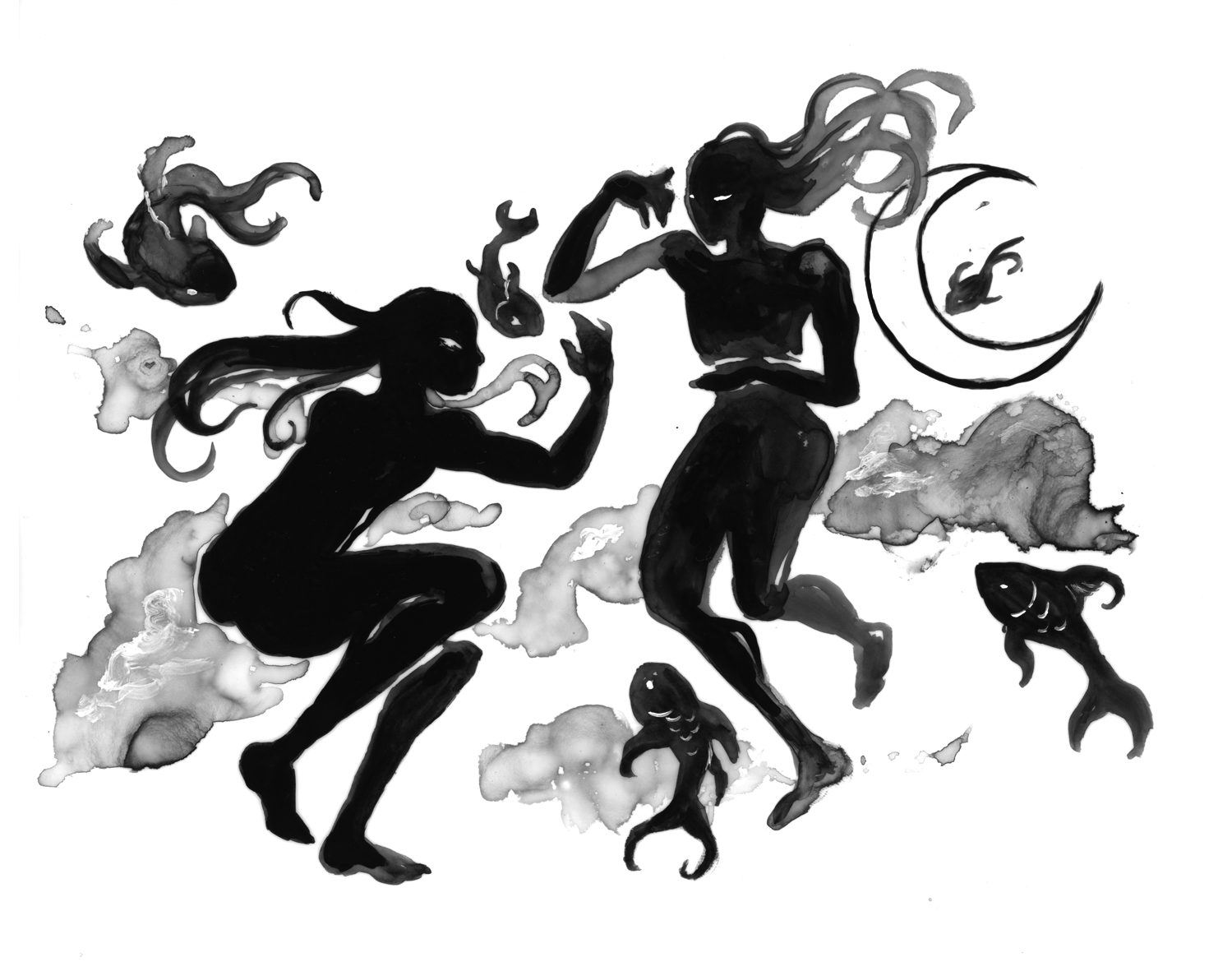
We live in a log cabin at the edge of a forest in winter, overlooking a frozen lake. The aurora borealis dances in the sky, ribbons of kaleidoscopic light reflected on the mirror-smooth surface of the ice.
We spend our days ice-skating on the lake and reading novels by the fireplace. In the evenings, we climb up onto the roof of our log cabin and jump up and down on the rooftop. It takes a few tries, but eventually we push off from the rooftop and keep on going until we’re floating in midair, bobbing higher and higher until we are within the aurora.
Fish swim through the aurora alongside us: eels, manta rays, jellyfish. They are creatures of silver light riding the air currents. I catch up to a school of tiny darting fish and grab handfuls of the slick, wriggling things. My companion chases an octopus and grabs hold of a tentacle, yanking the creature towards him. When we have caught enough for our dinner, we drift back down with our bounty. In our log cabin, we carve up the fish and cook them over the fireplace. We eat our fill, and then we sleep, our bodies pressed close against each other.
We live in surreal tranquility, the days melting into each other. How long have we been here? Impossible to say. Nothing ever changes to mark the passage of time. Maybe years; maybe decades.
For a long time, I feel perfect contentment here in this small, strange, and lovely place. But sometimes I catch my mind wandering. Is this all there is? Is there a world that lies beyond the frozen lake? Could we fly higher than the aurora, all the way into the stars?
“I’ve been thinking about exploring the forest,” I tell him across the dinner table as I lay out dishes of fresh fish.
“The forest?” he asks. “Why?”
I shrug, not sure how to articulate this faint but nagging ache of longing. Later, in bed, he strokes my hair and asks me, “Is it time to move on?”
Half-asleep, I mumble back, “I think so,” even though I’m not sure what he means. I feel his warm breath on the back of my neck as I drift off to sleep.
• • •
The sky was slate-gray and weeping. It was always gray these days. Someone told me it was because of the chemicals pumped into the atmosphere to stop the world from boiling. I’d never bothered to find out whether that was true or just another weird conspiracy theory. Didn’t really matter, anyway. Whatever the reason, the sky would still be gray.
I joined the end of a long line of tired-looking workers waiting for the factory doors to open. As the minutes ticked by, discontent rippled through the crowd. “They’re late,” the woman in front of me complained. “They shouldn’t make us stand out here in the rain. It’s not good for our health. The chemicals, you know.”
Minutes stretched into an hour. Mutters swelled into agitated babbling.
The wasted time chafed at me. If I’d known my shift would be starting late, I could’ve spent a precious extra hour plugged into StoryMaker this morning. StoryMaker always left me with a brutal headache, but I could never resist plugging back in. Unlike the human-made novels and movies priced at an impossible premium, StoryMaker ran on a cheap, infinitely iterative model, making it affordable for the masses. The immersive tech didn’t need a clumsy VR headset or haptic suit. StoryMaker interfaced directly with our brains via the government-mandated neural implants, projecting its simulated reality straight into our minds.
I hated StoryMaker: the garish colors, the slightly grotesque cartoon characters that populated its story universes, the nonsensical plotlines that made me wonder if I was having a stroke. But I needed StoryMaker. I needed a world where the sky wasn’t always gray.
A voice boomed out from a speaker, somewhere in the vicinity of the factory building. “Valued employees,” it said in a slow monotone. “We regret to inform you that your employment at Wilder Aluminum Works is no longer needed. We thank you for your loyal service.”
Cries of outrage erupted from the crowd. Several people surged towards the factory, beating their fists against the closed door. I wondered distantly if security would shoot them. But nothing happened. Eventually, their rage fizzled into resignation and they trudged away.
I just stood there, watching silently, feeling numb.
The factory door creaked open and a nervous-looking woman in a suit poked her head out. By then, only a small handful of dazed workers were still loitering around the factory entrance. She cleared her throat. “On behalf of Wilder Aluminum Works, I apologize for the inconvenience,” she said, stammering slightly. “To make your transition as smooth as possible and ensure that all available options are made known to you, we would like to offer you a new opportunity—”
“Are you gonna give us our severance payment?” the nearest worker interrupted.
She smiled nervously. “Uh, no. I’m afraid that for legal reasons, we are not authorized to disburse monetary compensation directly to laid-off employees. All requests must be processed through the State Office of Manpower.”
The worker spat onto the ground, turned, and stalked away. The others shuffled after him. I looked around and realized I was the only one left.
The woman in the suit heaved a deep sigh, as though she were the one having a bad day. “Would you like to hear about this opportunity?” she asked me tentatively.
I shrugged. “Sure.” It wasn’t as though I had anywhere else to go. Now that there would be no more paychecks, I was going to get kicked out of my apartment when I inevitably missed the rent payment due at the end of the week. Considering the line snaking down the street to the unemployment office every morning, my chances of landing a new gig anytime soon were low. I should have been panicking, but I felt only dull dread.
She brightened, shoving a brochure into my hands. “Thanks to an exclusive partnership with Dream Life, Wilder Aluminum Works is delighted to offer our laid-off employees the opportunity to skip the waitlist and register immediately for the Dream Life program!”
I bit back a surprised laugh. I’d heard of Dream Life in passing, but I’d never looked too deeply into it. With a waitlist stretching into the thousands, what would be the point? Plus, it may have sounded appealing, but it was obviously a scheme to persuade the less useful members of society to make a swift exit.
“It’s not enough to fire us? You want us to commit suicide for your convenience too?”
“Oh, no!” she said earnestly. “It is not suicide. Dream Life is just an alternative way of living. The fact is, there isn’t enough space and resources for everyone on this planet. But with Dream Life, you can live out the life you’ve always wanted while generously saving resources for our children.”
“Yeah,” I scoffed. “A few seconds of perfect happiness, then a lethal injection. Great bargain.”
“Oh no, no! That’s a common misunderstanding. Thanks to the Time-Dilated Perception Drug, those few seconds of happiness will feel like a lifetime—several lifetimes! That’s what makes Dream Life so revolutionary. In a way, Dream Life clients will outlive the rest of us!”
Right. I remembered reading about that too. The so-called Time-Dilated Perception Drug was supposed to speed up your thought processes until time seemed to slow immeasurably. Unfortunately, it also inflicted severe brain damage. Luckily for the Dream Life candidates, they weren’t planning to wake up anyway.
“If it’s so great, why aren’t you signing up?” I asked.
Her smile faltered. “Oh, I couldn’t. My family needs me.”
She patted my shoulder, smiled encouragingly, and retreated back into the factory. The door clanged shut behind her.
I looked down at the brochure in my hands. The illustration showed a woman silhouetted against a dreamy fantasy landscape. I skimmed through most of the marketing bullshit spiel, but paused at a line buried in a footnote.
“To ensure the safety of our clients, all candidates must undergo a thorough evaluation before they are deemed suitable for Dream Life. Room and board at the Dream Clinic during the evaluation period is fully complimentary. No commitment is required at this stage.”
I supposed it couldn’t hurt to check it out.
• • •
I jerk awake, heart pounding. I sit up and look around a small room with curved metal walls and hovering fluorescent lamps. This isn’t our log cabin. Where is the comforting crackle of the fireplace? Where is the glow of the aurora shining through our window?
A soft chime sounds at my door. “Come in,” I call, still feeling disoriented.
The door slides open and he walks through, looking sharp in his crisp uniform.
“Still in bed?” he laughs. “How much did you drink last night?”
Memories flood back of the award ceremony at the palace and the raucous celebration afterwards, driving away the last lingering impressions of winter air and northern lights. My hand goes to the brand-new medal pinned on my lapel. The same medal shines on his chest, proclaiming us heroes of the Intergalactic Empire.
“Enough to sate a hero’s thirst,” I say grandly, grinning up at him.
As officers in the Exploration Corps, we pilot ships through deep space, seeking undiscovered lands. He and I have trained together since we were children, competing fiercely for the highest rank in our class. When we were paired up for our first real mission, our rivalry deepened into friendship. Now he means more to me than anyone else in my life. Not that I would admit that out loud to him.
He wrinkles his nose at me. “Did you sleep in your uniform? Better get changed. You can’t turn up in front of the captain looking like that.”
“The captain? But this is supposed to be our week off!”
“Sure, you could take the week off. Or you could get your ass out of bed and join the mission. Didn’t you check your alerts? The Daylight has just been assigned to a newly discovered galaxy.”
My heart leaps. I jump to my feet, practically shoving him out of my quarters so that I can change.
The next day, we set sail into the uncharted territories of deep space. The voyage stretches from months into years. We visit dozens of worlds, each stranger and lovelier than the last. We save each other’s lives more times than we can count. After over a decade of exploration, I become the captain of my own ship, where he serves as my senior officer.
One quiet evening, I sit in my quarters with a glass of wine in my hand. I gaze through the window at the expanse of space outside, the inky blackness dusted with stars and nebulae. After all these years, the sight never fails to fill me with both dread and wonder.
Something catches my eye, and I squint closer. Among the stars I see something else, something I can’t explain: shimmering, rippling veils of iridescent turquoise and sapphire, tiny silver fish swimming within the rivers of light.
“The aurora,” I murmur, and suddenly I am filled with longing for a simpler time, for ice-skating and crackling fires and the icy air on my skin as I fly . . .
“What?” he asks. He is lounging across my bed, watching a movie on the screen embedded in the ceiling. Now he sits up and stares at me. “What did you say?”
What had I said? I shake my head. “Nothing.”
He looks at me, his face etched with worry. “We’ve been doing this for a while, haven’t we?” he says after a moment.
I grimace. “We have. We’re not as young as we used to be.”
“Is it time to move on?” he asks.
“Maybe,” I say, not quite understanding the bittersweet ache in my chest. “As long as you’re coming with me.”
“Always,” he says. We both turn to the window and look out into deep space, the field of stars alight with the colors of the aurora.
• • •
I sat in a small white cubicle in the Dream Clinic. A long wire connected the neural implant in the back of my skull with a smooth, featureless oval device. It looked a little like StoryMaker, except there was no screen.
A soft voice instructed me through my earpiece: “A desert landscape with two moons in the night sky. A storm-tossed ocean with a tentacled leviathan rearing from the waves. A futuristic city in the rain, streets lined with neon signs.”
I strained to visualize each scene with as much clarity and detail as possible. Even though I was still skeptical about this whole Dream Life thing, I didn’t want to flunk and get kicked out of these comfortable premises. It turned out that most applicants didn’t end up successfully qualifying for the program. The acceptance rate was currently less than five percent, although they said they were working to make it more accessible.
When the test was over, I emerged from the cubicle and was startled to come face-to-face with Dr. Dream herself. Her real name was Dr. Drew, but as the mastermind behind the Dream Life technology and the CEO of the startup, the nickname was inevitable. In the three days since I’d moved into the clinic, I’d glimpsed her inspecting equipment and talking to the nurses and technicians, but we’d never so much as exchanged a greeting before.
“Your visualization scores are through the roof,” she said without preamble. “What is your profession?”
“Uh, I’m a factory worker. Was. Got laid off.”
“Factory worker, really? Not a writer? Not an artist?”
I snorted. “If I were rich enough to be a writer or an artist, why would I be here?”
She nodded as though I’d made an excellent point. “You have an incredibly vivid imagination. That’s very important for a Dream Life candidate. The vast majority of applicants struggle to conjure up so much as an apple in their mind’s eye. I blame StoryMaker—that wretched contraption is feeding people trash and destroying their ability to dream. You don’t use StoryMaker, do you?”
“I do,” I admitted. “All the time.”
“But it hasn’t eroded your imagination at all. Interesting. How do you use it? Do you play along with the iterative storylines?”
“Sometimes, but those storylines always stop making sense after a certain point. Most of the time, I just use the settings, the weird imagery it generates. I instruct the NPCs to do what I want, come up with my own scenarios.”
Dr. Dream nodded vigorously. “Wonderful. You really are the perfect candidate for Dream Life.”
“Why?” I asked blankly.
Dr. Dream looked impatient. “Well, it uses the same immersive tech as StoryMaker, plugging straight into your senses via your neural implant, but it’s powered by you. Your imagination. You’ll have nothing but your own mind to rely on to come up with a lifetime’s worth of content, all condensed into the few seconds before death, thanks to Time-Dilated Perception. Do you understand?”
I was starting to. Despite everything, I felt a glimmer of excitement, a sharp ache of longing.
As a kid, it had been so easy to immerse myself in my imagination. I could lie in bed, gaze at the ceiling, and be totally transported to a wonderland of my own making, happy in the company of imaginary friends who felt vividly real. But I’d lost that as I grew up, just like I’d lost everything else. My family, swept away by a supertyphoon when I was twelve. My prospects and my future, gone with the meager savings that my parents had left me, nowhere near enough to pay for the education I needed for any shot at a career.
“Congratulations,” Dr. Dream said, tapping out something on her tablet. “You’ve passed your evaluation with flying colors. Let’s get you into a prep course ASAP. We’ll schedule your Dream Transition for . . .” She squinted down at the screen. “Two months from now. Yes, that should work out nicely. Finally, we’ll have a great candidate to show the investors . . .”
“Hold on,” I interrupted. “I haven’t signed anything yet. This is a big commitment. I . . .” I pictured myself on the operating table, hooked up to the Dream Life machine, a technician standing over me with a syringe, and fear twisted in my gut. “I’ll be dead. You’re going to stick a needle into me, and a few seconds later, I’ll be dead. I know it’s supposed to feel way longer than just a few seconds, but—”
“We’ll all be dead at some point, probably sooner rather than later if all those rumors about the war are true. But you.” She jabbed a finger at me, so suddenly that I flinched. “You, a factory worker with the soul of a dreamer, will get to visit heaven before you die.” She shrugged. “Or you can walk out those doors, spend a few more years eking out a miserable existence on this wasteland we call Earth, get cancer from inhaling too many factory fumes, and die a painful death in some under-resourced hospital ward.”
I thought about the factories puffing endless gray smoke into the gray sky. I thought about the cold gray apartment complex where I lived—and had probably already been evicted from, since I’d disappeared without making rent. If I refused to proceed with Dream Life, I’d be kicked out into the gray streets in a gray city on a gray planet dying a slow, suffocating death. The only beauty that existed in this world was the beauty I created in my mind.
“Okay,” I said. “I’ll do it.”
• • •
I step back, gazing up at the enormous landscape painting mounted on the gallery wall. My heart swells with pride. I did that, I think, and I can scarcely believe it. I created that.
“It’s stunning,” he says, kissing my cheek. “I’m so proud of you.”
I smile at him, wrapping an arm around his waist. I bask in this moment, the culmination of all my hard work, all those tear-stained canvases and rejection letters. Now, at last, I taste the sweetness of success. I watch as patrons mill around the gallery, murmuring appreciatively as they peruse my art. This is just the beginning. My mind wanders towards a glittering future: awards, television interviews, fame and riches.
“I think I’m proudest of this one,” I say, leading him towards the next painting. It is the aurora borealis in swirls of iridescent paint and glitter, with dozens of ghostly sea creatures swimming in the sky amid the ribbons of light. In the middle of all of this, almost too tiny to see, are the outlines of two people floating side by side. I point at the two tiny figures.
“That’s us,” I say teasingly. “In another life.”
I turn to him, expecting another effusive compliment, but his smile has faded. He lets go of my hand and wanders towards the next painting. Surprised and deflated by his reaction, I follow him. He is looking at a painting of a spaceship flying through a star-frosted sky, against the distant background of a pink-and-purple planet.
“The Daylight Voyages,” he says softly, reading the title from the plaque beneath. He walks slowly around the gallery, looking closely at each art piece: a quaint farm in an idyllic countryside, a medieval castle against a fantasy landscape, an underwater city with two mermaids swimming hand in hand.
Finally he stops in front of the last painting, almost hidden in a far corner. In this painting, a naked figure lies on a stainless-steel table in a sterile white clinic, a wire plugged into the neural implant in the back of the patient’s neck. Two doctors in white coats stand over the patient, looking at readouts on a screen. It’s titled The Dream Clinic.
He turns to me at last, and I’m startled to see that his eyes are filled with tears. “Everything’s starting to fall apart.”
“I don’t understand,” I stammer.
“It’s time to move on,” he says. He kisses me and the world darkens.
• • •
Only ten successful candidates passed the evaluation and made it to the preparatory course. We sat in a makeshift classroom, scribbling notes as Dr. Dream lectured.
“At the point of death, there is often a surge in activity in the region of the brain responsible for dreaming and hallucinations. Along with the drug that induces Time-Dilated Perception, you will also be pumped full of a chemical cocktail that capitalizes on this surge of brain activity to send you into Dream State once you’re plugged into the immersive device. How many of you have ever experienced lucid dreaming?”
A couple of hands went up, mine included.
“It’s a little like that,” Dr. Dream said. “Except that only a small, compartmentalized section of your consciousness should be lucid, responsible for creating and guiding you through the dream scenarios. The rest of your consciousness should be fully immersed in the dream. If you are fully aware that nothing is real, that your physical body is at that moment dying in a clinic? Well, your Dream Life could turn into a Nightmare Life pretty quickly. No one wants an existential crisis that lasts for what feels like decades.”
Noticing the confused, startled looks from the class, she made a placating gesture. “Okay, let’s try this from another angle. How many of you had imaginary friends when you were kids?”
Around half of the room raised their hands, including me.
“Did that imaginary friend ever become so real to you that they almost seemed like someone with agency, not just an extension of yourself? Did they ever say and do things that didn’t seem like they came from you at all?”
I nodded.
“Think of this lucid part of yourself as an imaginary friend,” Dr. Dream said. “It’s still you. It’s still your mind in control. But separate.”
I could tell many of my classmates still had no idea what she was talking about. But I knew exactly what she meant.
After we learned the theory, it was time for practice. Nurses bustled around the class, setting everyone up with intravenous drips and plugging our neural implants into the StoryMaker-like immersive device. Dr. Dream told us that we would be given a hallucinogenic that mimicked the effects of the drug cocktail that would be administered at the point of our deaths. I sat back, closing my eyes, and tried to focus on the mental exercises she had taught us.
The first few sessions were frustrating. Each time I drifted into a fitful half dream where nothing seemed to make sense. I awoke trembling and gasping, wondering if I should drop out of the program. Was it worth the risk that I might end up entangled in centuries of a fever dream?
During my fifth attempt, I was drowning in rainbow quicksand under a pink-and-silver sky. Sand streamed into my nose and mouth. I couldn’t scream. I clawed desperately for purchase.
A hand found mine and pulled. I emerged from the quicksand, gasping for breath. I turned to look at my savior, and he . . .
• • •
He is behind me, gripping my arm to steady me. I look around, disoriented. I am in a castle made of crystal, sitting on a raised dais beneath a glass ceiling.
I draw in a shuddering breath. Scattered images flutter across my mind’s eye: a chandelier-lit art gallery, a glass of champagne in my hand, the star-frosted darkness of deep space, the colors of the northern lights, a needle sliding into the soft flesh of my forearm.
“Focus,” he urges, and I close my eyes for a moment. When I open them again, I know who I am. I rule over the Crystal Kingdom, a harsh and beautiful land where crystalline structures grow in place of trees. Our beauty is the envy of the whole world. We have been besieged by enemies through the ages, but we remain unyielding . . .
The memory of Dr. Dream’s voice echoes in my ears. “You, you, will get to visit heaven before you die.”
Heaven. Is this heaven?
I stagger down the dais, gasping for breath. The ground is trembling, and pieces of the crystal walls shatter and crumble. He pulls me forward as the ground beneath my feet caves in. We stumble away, gasping and panting, as the world implodes around us. A cracking, groaning sound reaches my ears. I look up to see fractures spiderwebbing across the glass ceiling.
• • •
The metal was cold against my naked back as I lay on the table. I watched as they slid the needle into my vein.
It felt like it took hours for my eyelids to close.
• • •
The glass shatters, and all at once I remember everything. I almost buckle under the weight of it, all that time. I remember my first life, my “real” life, short and monochrome. I remember all the lives I have led since. All the people I have been. All the universes I created.
He grabs my shoulders, resting his forehead against mine.
“It felt like centuries,” I whisper.
“More than that,” he says. His face flickers. I catch glimpses of all the people he has been to me: lovers, friends, family. “Almost an eternity. Almost.”
“It’s still not enough,” I say, even though I’ve gotten more time than anyone was ever meant to have. “I still want more.”
“I know,” he says. “But this is all we get.”
I look at him, this companion of my soul, who is made of me but has somehow become more than me. I see a thousand iterations of him in a thousand dreams. I take his hand and we run as the ground crumbles behind us, pieces of our past lives falling like rain. The aurora snakes through the air above us, fish leaping in the shimmering rivers, until it all bursts into splinters of light.
• • •
In the Dream Clinic, my body lies on a stainless-steel table. My blood flows sluggishly. My pulse stutters.
• • •
Just before the ground collapses, we leap together. The force of our leap carries us forward over nothingness. In that moment, he and I exist untethered in an empty universe; nothing above us, nothing below.
• • •