

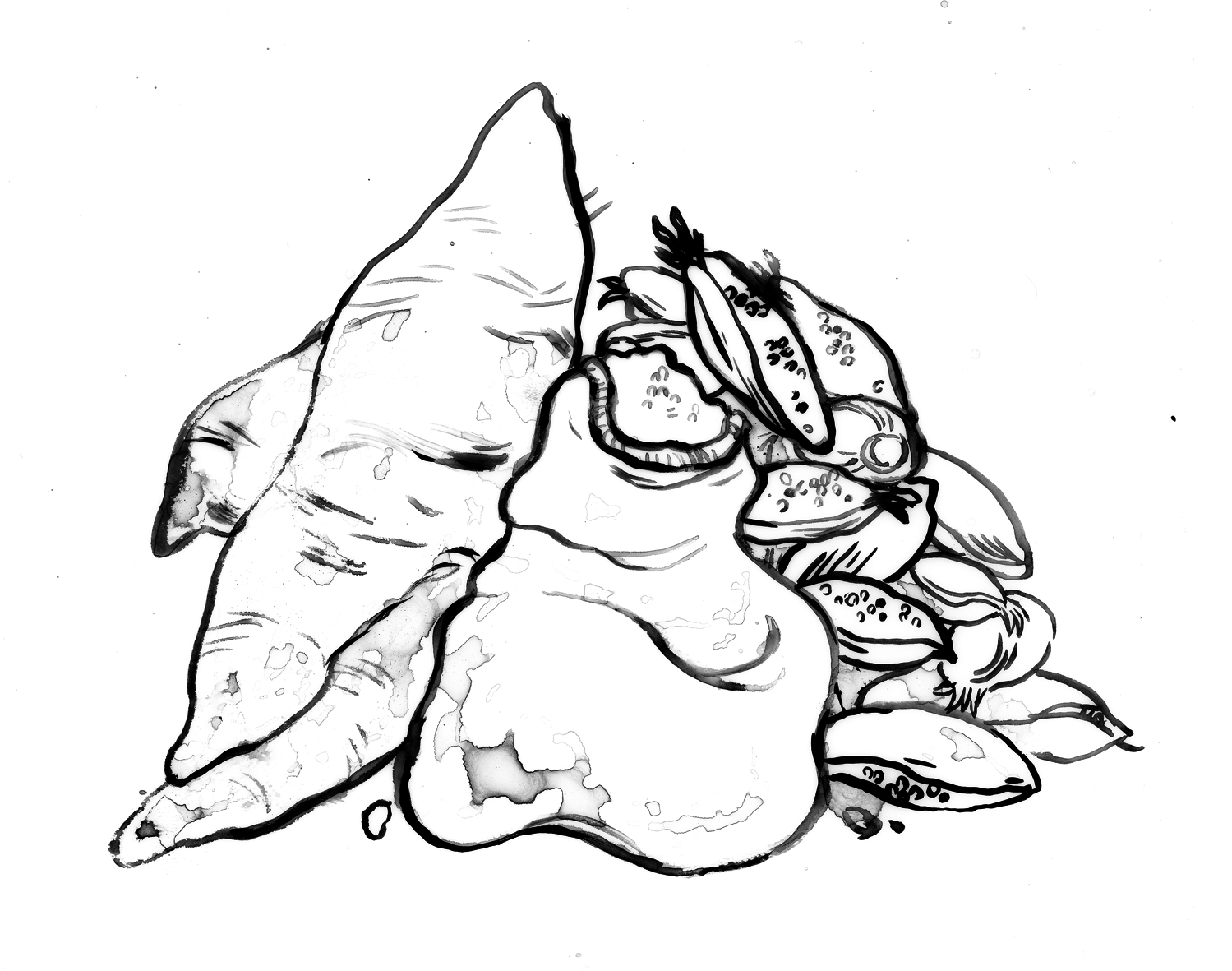
The Kuyes have been fighting. The Kuyes have also been hungry. These two problems go hand in hand.
To tell their story is to travel backwards on several beaten paths at once, in search of where their journey began. I will be your guide. In this tale, there will be wars and rumours of wars. Plagues, famine, and weeping sores. You will hear of witchcraft and superstitions and the new gospel that was spreading further upwards into the country—word of new churches opening in Oye had reached Ejiba. But a story heard only with ears is half told. For this story to be fully told, you must open your mouths in shock as we join Mama Aramide, of renowned fame in the markets of Aramoko, as she sees her only daughter, Aramide, vomiting by the tangerine tree next to the gate.
One moment, Aramide was sweeping the yard, clouds of dust rushing forward and collapsing in waves. The next, Aramide was doubled over, hand against peeling bark, ridding her stomach of the early morning ogi and akara she’d eaten reluctantly under her mother’s watchful eye. Mama Aramide stood in the shadow of the doorway, saying nothing. The day was still young; her suspicions could still be proven wrong.
They were not. The sky continued to yawn brightly as lone skinny clouds drifted across, and then the land cooled and a gentle chill came on the breath of the evening breeze. Through it all, Mama Aramide’s eyes followed her daughter. The girl darted to the farm behind the house as soon as she had emptied iru onto a tray and placed it in the sun to dry. She walked around the compound, huffing and puffing, holding her lower back, complaining that it was sore from harvesting yams the day before. By nightfall, Mama Aramide knew what must happen.
To understand Mama Aramide’s decision, you must first understand that success is not free. I, myself, dabble in the trade and I can tell you that to have something, you must lose something. It is a simple law of nature: death fertilises the soil from which all new things sprout. Mama Aramide understood this well. When she was a very young girl, she ran from Ife to Ilesa, leaving her family behind in exchange for her independence. Then she left Ilesa for Aramoko many years later, a child wrapped against her back, because she realised independence was as useful as cow shit in the desert if you didn’t have your own money. When she arrived in Aramoko, she visited a very powerful man—one whose power demanded whispers and bowed heads, one who I am very familiar with.
I want to be wealthy, she said. I want my daughter to inherit my wealth.
The man nodded. He arranged cowries on a red cloth. He scratched his grey-black beard. It can be done. But there is a condition.
Like I told you, Mama Aramide understood this. Life always hands you a gift with one hand hidden behind its back.
I will do anything.
The man grunted. He rearranged the cowries, narrowing his eyes. Then he looked up at her and spoke, his voice hoarse. Under no circumstances must you lay eyes on your daughter’s child. If you do, there will be grave consequences.
Mama Aramide frowned. Her little girl was still very young. There was time to build something great. Something she could leave to her daughter. I understand. But will my daughter at least inherit my wealth?
There was a moment of quiet contemplation. Then, the man nodded slowly. The chances are good that she will.
So, you must understand, the evening Mama Aramide realised her daughter was with child was the evening Mama Aramide saw the sun set on her dreams. She had built a name in the markets of Aramoko as a consummate trader, shrewd and calculating. And what is a better thing to give a newborn than a good name? So, as the sun rose the next morning, Mama Aramide sent her daughter away, with a raffia bag full of clothes, tin cans of milk, and boxes of sugar, and told her to live with the baby’s father. Aramide wept and then begged and then cursed her mother, but eventually she turned and started to walk away. And as Aramide watched her daughter walk away, she finally understood that there can be such a thing as a deal too good and an exchange too great. This is where we can say the story begins.
Aramide walked all the way to the town square, where Babajide had set up his little leatherworking station. Babajide Kuye grew up in a small town called Ijelu, at least a day’s journey by foot. His father was a priest. As one of the only preachers in the region that wasn’t a missionary, Babajide’s father had not grown up in the faith but chose to convert after witnessing a miracle no other power could explain. All through his childhood, Babajide listened to this story in the dark, the faraway glow of a kerosene lamp turning shadows into willing dancers that spun around their parlour as his father narrated. I will tell you, like Babajide heard it:
Once, when I was young, I went up to the well to fetch water. I had a few friends who usually joined me on this journey, other boys who have now become men—like Tunji, whose daughter works in Lagos now, and Korede, whose children are dead. This particular day, a missionary, tall and flushing red in the afternoon sun, was preaching to everyone who would stop to listen. We made fun of him, his dripping brows and sopping cassock. One of us said: If God loved you, he’d let you wear khakis like the other white men. We knew nothing then. We were like the children that mocked Elijah. Eventually, we got to the well and took turns fetching water while the rest ran around. Then, all too suddenly, one of us slipped, tipped over the edge of the well, and plummeted. We screamed. I tried to peer down, but the hole was cavernous darkness. We heard splashing. Our screaming alerted the missionary, who ran over, huffing and puffing, cassock waving in the wind. He told us to step aside and he said a prayer. There was a lull, a brief moment dwelling between faith and doubt, wherein the children turned to look at the missionary with wide eyes and open mouths. But he was kinder to us than Elijah, because quite suddenly, the water in the well rose and rose and rose, until our friend could climb out himself.
Babajide heard this story many times, and when he was younger he once sought out the well. He expected the site of something so momentous to feel divine. They could have even put up a sign. Instead, the well felt like an ordinary cylinder of brittle bricks, and as he peered down, the unyielding darkness made him doubtful of water suddenly rising from within. Besides, wouldn’t it have been quicker for the missionary, surely much stronger than the little boys, to throw down a rope and pull him up? Nonetheless, Babajide kept his thoughts to himself, believing that to question someone’s faith would be to pour sand in their garri.
When he was old enough, Babajide declined to join the seminary and instead learned leatherworking in one of the missionary trade schools. This took him all the way to Ibadan, where the wide roads, the large concrete buildings, the sheer bustle permeated his bones. By the time he returned to Ijelu, he was restless, talking about starting a family and moving to the city.
His father tried to dissuade him; times were changing and, at twenty, there was a lot more a young man like himself needed to do before he could care for a family. Marriage is the first step in a life of hard decisions. You will need to stand by your wife through all of them. Are you ready for that?
The concerns fell on deaf ears. For you see, Babajide had pissed in porcelain, walked on tar, sat across white men at bars vying for the attention of the same women. And oh, God! The women! In Ijelu, he’d eyed them walking to farms or cooking over fires in their front yards. He’d even attempted to woo a few. But at the end of the day, he’d lived with his father, who preached about the virtues of keeping one’s self. But in Ibadan, far away from his father’s gaze, he ran his hand down women’s backs, slipped his fingers between their legs, pressed his body against theirs, tight on his mission bed, moving slowly so the springs wouldn’t creak as loudly. He was now a man, and God knew it, he deserved a wife. So, against his father’s judgement, he picked up his leatherworking tools and went up to Aramoko to repair bags, briefcases, and shoes, find a wife, and make enough money to return to Ibadan in style.
This was the dream Babajide fed Aramide, talking about the wonders of the city, leaving her in awe because all she’d known so far was her mother’s home and hard work. Babajide told her: In Ibadan, there are cars everywhere. Babajide told her: In Ibadan, I will have a job in one of the colonial offices, and there, I could even go to London! Babajide told her: I want to marry you and take you with me. Babajide told her: Open your legs. And she did.
Of course, when Aramide appeared at Babajide’s stall in the market square, he did not know what to do. She had tears running down her face, a bag slung on her shoulder, and a simple adire wrapper knotted high on her chest. Babajide, despite his big dreams, did not have the means to house and feed another person, much less one who was pregnant. But he was too good a man to break his promise of marriage. And so, later that day, Babajide and Aramide Kuye started their journey to Ijelu.
It is at this point that I have to ask you: What is a curse? How do you curse someone? Did you know that it is possible for a curse to not take because the mark does not receive it? I suspect you have not considered these things because you do not like thinking about how bad things happen. The truth is that a curse is like a loose thread. The first time you notice it, the best thing to do is sever it from the base. Waste no time. Do not leave it free, do not leave your hands idle. Because if you do, what happens? You pull at it. And the moment you do, the whole garment is doomed, no matter how little you wear it or how gently you care for it. It will unravel all the same. With a curse, no matter how far you run, as long as you do not sever it, you will end up pulling at it, asking it to come closer and closer, until it finds you naked and afraid.
But for now, the small turmoil that should have warned Mama Aramide that a storm was coming settled unremarkably. Mama Aramide wept for a few days but ultimately took it as a consequence of success. She asked around the market for where her daughter might have gone and took the answer as cold comfort; at least her daughter would be fine. The Kuyes moved into Babajide’s father’s house in Ijelu and got married. They had a little baby boy they named Bamidele.
A handful of years whizzed by. Mama Aramide’s trading continued to grow—she was now a household name in homes as far as Abeokuta. Babajide continued his leatherworking, all the while dreaming of the city. Aramide did not have success or dreams. Relegated to silence in a home that wasn’t hers, she took care of baby Bamidele quietly, cleaned what was now her family home quietly, and cried about her mother quietly.
And then the war started. Such wars don’t concern anyone in our tale. It was a war fought on foreign soil over big ideas, such as discrimination and hatred, with big guns and very fast planes. And yet, news of this war, being fought on hills, in valleys, and on beaches in Europe, made its way to Aramoko. Mama Aramide first heard of it in the marketplace where travelling salesmen came with less and less to sell, citing the war. It’s hard to find fabric. It’s hard to find salt. It’s hard to find dye.
Mama Aramide was unconcerned at first. She had amassed astonishing wealth that she stored in gold, so she was not worried about slowing business or inflation. But then, as the war dragged on and 1942 rolled into 1943, the rains stopped. The dry season started in December of 1942 and overstayed its welcome, suckling plants till they were dead brown stalks tilting in dry loose soil. Soon, it was not that food was hard to find—there just was no food. This was when Mama Aramide realised she could not eat gold. Money, no matter how much, is useless if there’s nothing to buy. Mama Aramide carefully rationed what she had left and began searching for food, all the way down to Ibadan and then Lagos. Sometimes she found something small, a few ears of corn here, a small paint bucket filled with beans there. If whatever she bought made it home with her, it did not last long. But more often than not, it was stolen on the way as she travelled past many scrawny, bony hands and red, sunken eyes. Because even in places where the famine had not reached, lack had taken root. Still, the odds that Mama Aramide would make it to the end of the famine alive were good.
Until, like an explosion, someone in Aramoko felt a tickle then a sting deep in their chest and coughed, tiny droplets of blood splattering against the inside of their teeth with each racking breath and forceful contraction. Pẹhẹ, like all diseases, preys on the weak, and with many starving, it quickly tore through Aramoko. This was when Mama Aramide realised she had to leave. There were rumours that some places, smaller village towns like Ijelu, still had stubborn soil that sparsely grew cocoyam and palm trees. Boiled cocoyam and palm oil once every few days was hardly enough to fill a belly, but it was just enough to keep one going. And so, that was how Mama Aramide found herself making the day’s journey to Ijelu with a big box of gold trinkets, the culmination of her life’s work, to be reunited with her daughter.
It may be that she forgot the warning. It may be that she thought it did not matter anymore, that the consequence was hers to bear, that she could reunite with her daughter and hand the wealth over and die in peace. Or it could even be that she sneered at the idea that there was worse that could happen than slowly starving in a house full of money as pestilence roamed the land. Whatever she thought, she arrived at Ijelu and found the Kuye household and stood at the gate. Her daughter, who was sweeping the yard, stood slowly and blinked rapidly. Aramide thought she was looking at a spectre. But rather than disappear, Mama Aramide drew closer, the distance vanished, and then mother and daughter were hugging, weeping into each other’s shoulders. At a distance, four-year-old Bamidele waddled out into the yard, and over her daughter’s shoulder Mama Aramide saw him and smiled.
She should have realised that in the game of curses, there can always be worse, and there are fates worse than death. Instead, she caught up with her daughter, met Babajide and his father, learned how the famine had been hard for them too, and promised to help however she could to make up for her presence there. And then she went to bed.
What came next was not my fault. I cannot create wars. I cannot dry the soil and rob the sky of clouds. Sending plagues is beyond me. But, from the very moment the powerful man in Aramoko warned Mama Aramide of consequence, I was spun out of nothingness, tender and thin. I stuck to Mama Aramide’s iro, and because she could not do what was necessary to sever me completely at the beginning, it was only natural that I would manifest. I did it like this: in the early hours of morning, Mama Aramide turned into three big tubers of yam, sitting gingerly on a brown and white bedspread.
At this time, the Kuyes were on their knees, on opposite sides of their bed, praying. Or rather, pleading. Pleading, soft like water trickling over rock, escaped their lips, libation for whatever ears were listening. Babajide still was not a man of faith, and Aramide had no strong affinity for religion. But in Babajide’s father’s house, the default was to worship the one and only God, and in times like this—of much suffering and gnashing of teeth—prayer held similar conviction to action. It was the only way of doing something. Besides, it was their sincerely held belief that dawn holds a special magic—it is a time when water pulls itself out of thin air to gently wash leaves clean. If you are begging God to change your story, what better time is there than when he is patiently cleansing his creations? If there was a chance that hunger, this rock in their lives they were desperately trying to wash away, could be solved by a few words muttered in the early morning, then why not try?
Hunger is a vacuum. Hunger is a hole. Hunger is a thing that starts as a single bubble, rising to the top, pushing all out of the way as it swells, until it bursts, just to reveal its emptiness. You will never understand how badly emptiness like this can sear or the kinds of decisions it can push you to make. This is what Aramide thought, with wet cheeks and red eyes, as she peeled the third tuber of yam that used to be her mother in the backyard, the sun setting and her stomach full with generous helpings of the first two tubers.
She had been the one to find her mother gone and the yams sitting there, thick and healthy, each one as long as her forearm. She had screamed and screamed and screamed, first for her mother, then for her loss, and finally for the callousness of it all. When Bamidele, Babajide, and his father gathered in the room to see, they joined in the shouting too. Babajide’s father fell to his knees, praying. Bamidele blinked, confused. Babajide rubbed Aramide’s shoulder as her screams morphed into sobs and then quiet sniffles.
It was midday before anyone suggested what to do with the yam. They were all seated in the living room, arms crossed, staring into the distance, when Babajide bit his bottom lip and spoke: “So, do we eat the yam?”
Aramide gasped, and Babajide’s father frowned, immediately beginning a tirade about how the yam needed to be burned and they needed to pray harder because evil had found its way to their home.
Babajide nodded and nodded, and said nothing, but after Babajide’s father went up to the church to pray, Babajide pulled his wife aside. “Aramide, I don’t know how we’ve gotten here, but we’ve been praying. We’ve prayed every morning, and I know it’s difficult to believe, but what if this is our prayer answered?”
Aramide said nothing. She thought back to when she first met Babajide, bright-eyed with a shifting tongue, in the market. She looked past Babajide, through the living room window, and into the front yard, where she could almost see herself, all those years ago, sweeping.
“Aramide, think about it. There is no food. We’re managing with cocoyams and there’s barely enough to eat every few days. This much yam? We can eat our fill! Is that not good? Especially for Bamidele. He’s a small boy. He needs as much as he can get to grow strong and healthy.”
Aramide turned her attention back to her husband. The famine had forced him to wither away—his collarbones had risen out of his chest like ridges, and the sunken valley between each collarbone and shoulder blade was now deep enough that she imagined grabbing him there, like a handle, and shaking him violently.
“Besides. I know you were happy to see her yesterday. But she abandoned you, remember? She did not care to reach out or check in on you. Not even once. You had a child and she didn’t come. And then she came because there was no food? It feels like this was divinely mandated.”
Aramide remained silent as Babajide hugged her and then fetched the yams. He placed them at her feet and looked into her eyes, as if to say, You know what to do. So Aramide picked them up and went to the backyard to peel and slice them, one tuber at a time, each time boiling, each time presenting a plate to Babajide and Bamidele, each time taking her plate outside, in tears, because she couldn’t bring herself to eat in front of her family.
Belly full, Babajide burned the yam peels in the yard as a big sign of obedience to his father. When the old man returned much later that evening, he nodded in appreciation. He was wearing his cassock, which was now an ocean of fabric drowning his emaciated frame. “Good thing that you listened. God told me it was a curse, one we do not want any part in.”
Babajide’s father was right in a sense. You can call me a curse. I am the aftermath, ramification incarnate, and for many that is what it means to be cursed—to have to bear witness to your own actions. Because every action carries with it the weight of conviction, there will always be new complications flowering on the rotting corpse of the original decision. So the old man was right that Aramide’s mother came bearing a curse. But he was wrong that they could choose their part in it. For, from the moment Mama Aramide had come, Babajide’s tomorrow had started to manifest. And when, one week later, after not seeing his father all morning, Babajide opened the old man’s bedroom door to find twenty ears of corn, green and golden-haired, scattered across the floor, his tomorrow arrived.
Babajide was secretly trying to fit all twenty ears into a burlap sack, his jaw set, when his wife knocked on the door. She opened it and stepped in before he could hide what he was doing.
“Babaji— Oh.”
Babajide looked down at the sack filled with corn, little yellow kernels as bright as the sun shining through gaps in the green husks, and then up at his wife, whose eyebrow was raised and whose lips were pressed flat.
“Where is your father? Someone from church has come to see him. He probably wants to ask for a cocoyam or two.”
Babajide mumbled something under his breath, unable to gather his thoughts. Aramide stepped into the room and walked up to the pile of corn and the sack that Babajide, crouching close to the floor, was now guarding.
“It’s okay. If you can’t find him, I’ll just take some of this corn and give it to the person looking for him. I’m sure he wouldn’t mind.”
She reached down to pick up an ear of corn, but Babajide slapped her hand away.
“No. You can’t take him.”
Aramide stood up straight and looked down at her husband. The man’s face had become so taut that his eyes bulged. He’d always had big eyes, wide and unblinking. Years ago, she’d found them endearing, especially how they’d widen into an unfocused gaze when he was talking about Ibadan. Now, Aramide found the way he glared at her intently, eyes dark and yet still so wide, disgusting. She couldn’t say he was a different man; he was the same person, all he’d lost was the luxury of dreams. She bent again to pick up the corn, swatting away his hands when he protested. After selecting five ears, she stood and turned on her heel. Then, just before she left the room, she spoke very softly: “I’ll give the man from your father’s church these. Then I will come back and we will boil the rest. Thank you for being brave enough to do, yourself, what you asked of me a week ago.”
True to her word, she returned. Her husband was still seated by the sack, eyes still wide, staring into the distance. She gathered the rest of the corn into the sack, took it outside, and tore off the husks and hairs before placing the ears into a big pot. Later that evening, they ate corn in their dark living room, all the while ignoring Bamidele’s questions about where his grandfather went.
I did not enjoy this next part, but it was necessary. One afternoon, towards the end of the famine, just as the first rains were beginning to stir, Aramide returned from an afternoon coaxing what little cocoyam she could out of the ground, a basket balanced on her head, to find her husband, seated just in front of the house, eating white rice and palm oil from a tin plate. Aramide stared for a second, allowing the sight to settle, before dropping the basket and sprinting indoors. She ran through the living room, peered into the spare room, where her mother had turned to yam, ran past the open door of her father-in-law’s room, where he had become corn, and finally arrived at her and Babajide’s bedroom, where a large bag of rice lay on the floor, cut along the midsection so that rice spilled out onto the carpet.
She ran back outside, screaming for Bamidele along the way. In front of the house, Babajide had now finished his rice and was peering into her basket, counting the cocoyams inside. He heard her screaming, a banshee tearing through the house, approaching him. There was no little boy to be found, no child waddling out from where he had been hiding. Before Aramide could tackle Babajide, he spoke over his shoulder: “You should eat. We’ll have to go to Ibadan very soon.”
And so, my work was complete. I am not one to overstay my welcome; I did what I needed to do, which was to link past to future. As you do, so it is—a tenet by which all must abide, no exceptions. The rains fell, and with the rains came life. Plants started to bloom. People celebrated because soon the famine would end. People in larger cities heard that the big war, still being fought, might soon be over. Pẹhẹ tore through Aramoko and a few surrounding cities, but it eventually vanished as suddenly as it had appeared. Babajide and Aramide slept in separate rooms at night, doors locked, and swam through thick fear in the house by day. During this time, Aramide found her mother’s box of jewellery, all that she had wished to pass on. Also during this time, Babajide realised that even if Aramide didn’t turn into food, if she disappeared, he could finally go to Ibadan. Or, better yet, Lagos.
The Kuyes have been hungry, but the famine is ending. Do not attribute to me the end of this story, for I have moved on to other deserving people. But, from the corner of my vision, I may have caught one end of this tale: the Kuyes fight a final time, and one of them dies, and the other, now rich, leaves for the city.
• • •